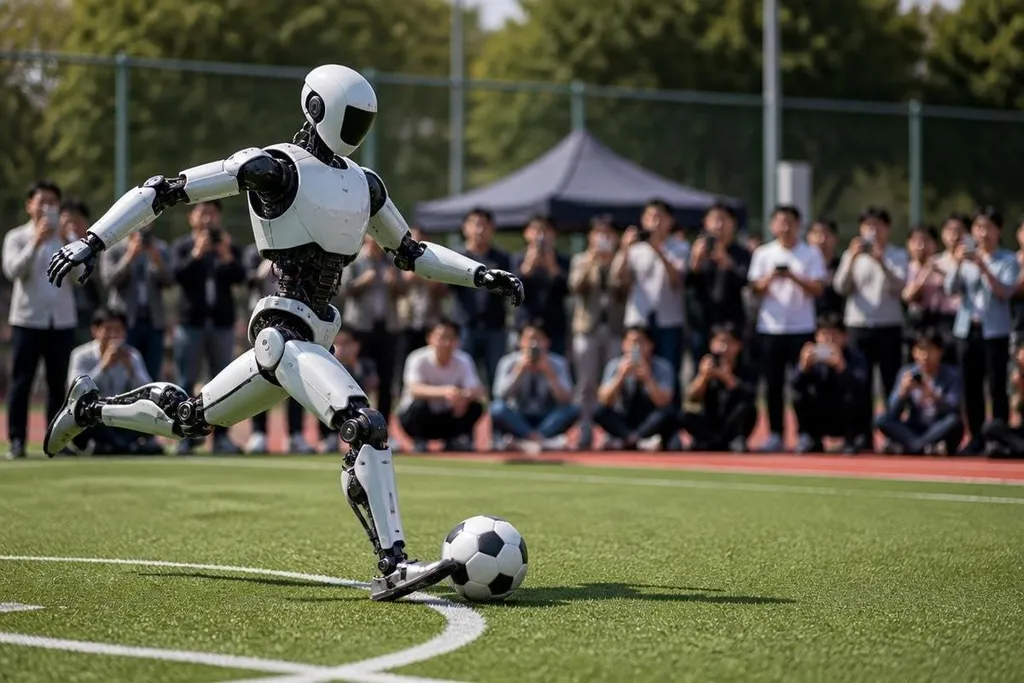
Running, kicking, balancing, throwing, and stopping give a sports robot a task people understand at once. That makes robotics easier to watch than a machine working inside a factory, even though the public video rarely shows the full test.
The appeal is real. The size of the market is harder to judge without figures on sales, repeat use, or paying customers.
- Sport gives robots a clear score: time, distance, accuracy, or points.
- Cameras make balance, speed, and failure easy to see.
- The same hardware can test skills needed in work and research.
Sport gives robots a clean test
A robot in a warehouse may need to move safely around shelves, people, software rules, and changing orders. A sports robot faces a narrower task. Its result can often be measured with a clock, a marked field, or a target.
That matters because a clear score lets engineers compare two software versions or two kinds of hardware. A robot that finishes a course in less time has a visible result. A robot that falls at the same turn has a visible problem.
The sport itself supplies useful tests. Running checks gait, which is the pattern of leg movement. Kicking checks balance, foot placement, and the robot's ability to handle a sudden change in force. Throwing checks timing and arm control.
These tasks still need careful measurement. A short video can show a successful kick, but it may leave out failed attempts, remote control, pauses, or changes to the field.
Videos make progress easy to see
Sports already have a language for performance. People understand a sprint, a goal, a jump, and a fall without a long explanation of the robot's software.
That helps companies and research teams explain their work. A video of a robot crossing uneven ground can show balance more clearly than a list of sensors. A match can show how the robot reacts when another machine blocks its path.
The format also creates a risk. A polished clip may show one successful run rather than repeatable performance. The useful questions are plain: How many attempts were recorded? Was the robot controlled by a person? Did the clip show the full run? What happened when the robot failed?
A sports demo needs a record of the task, control method, number of runs, and result. Robot24 can help you follow those details across companies and machines before the discussion moves to other jobs for the same parts.
The same parts can serve other work
Sports robots need hardware that also matters outside sport. Cameras help a robot locate objects and read its surroundings. Force sensors tell the control system when contact changes.
Motors, gearboxes, batteries, and onboard computers decide how long the robot can act and how quickly it can respond. A robot that keeps its balance after a push may teach engineers about walking systems for inspection or transport.
A robot that finds a ball may use vision methods that later help an autonomous system find a tool or a package.
The link is useful, but it has limits. A field is not a factory floor. A clean indoor court does not test dust, rain, tight spaces, long shifts, or the safety rules found around workers.
So sports can act as a test site for parts of a robot's design. They don't prove that the full system is ready for paid work.
Popularity needs more than video views
The word “popular” can mean public attention, research funding, product sales, or regular use by sports teams. Those measures point to different things, and a strong video may prove only the first.
A buyer should look for evidence that lasts beyond one event. Repeated runs, public test rules, clear control methods, and named customers tell you more than a fast clip with no test details.
I’d treat claims about rising demand as unproven until a company shows orders, paid deployments, or repeat use over time.
A practical check before you trust the claim
Use this short check when a sports robot appears in a new demo:
- Watch the full run: Look for cuts, pauses, camera changes, and resets.
- Check control: Find out whether a person chose each movement or only set the task.
- Find the score: Look for time, accuracy, distance, failed attempts, or match results.
- Read the conditions: Note the floor, lighting, weather, load, and number of robots.
- Ask about use: Separate a research test from a paid sports or industrial deployment.
A sports robot earns attention when its task is clear and its result can be checked. The next useful proof is not another polished clip. It is a repeatable test that shows how the robot performs after the novelty has worn off.